Getting around Sicily without a car is entirely possible — but it requires understanding how the system actually works rather than assuming it functions like public transit in northern Europe or the US northeast. Sicily has trains on the main coastal corridor, a reasonably good intercity bus network, ferries to the islands, and taxis that are affordable by European standards.
What it lacks is comprehensive coverage of the beaches, hill towns, and rural sites that make up much of the island’s appeal. This guide covers every option in practical detail so you can plan a car-free trip with realistic expectations.

Sicily’s Train Network: What It Covers and What It Misses
The most useful thing to understand about Sicilian trains is that they serve one main corridor well and most of the rest of the island poorly or not at all. Once you know the corridor, you can plan your bases around it.
The main line runs along the northern and eastern coasts: Palermo – Cefalù – Messina – Taormina/Giardini Naxos – Catania – Syracuse. Trains on this route run throughout the day; the journey times are reasonable (Palermo to Catania takes about 3 hours, Palermo to Cefalù about 1 hour; Catania to Syracuse about 1 hour 20 minutes), and the stations are generally well-placed relative to the towns. If your itinerary stays on this corridor, you will find the train genuinely useful.
Beyond the main corridor, several secondary routes are worth knowing: Palermo to Agrigento runs direct in about 2 hours—slow but functional, depositing you at Agrigento Centrale, which is a significant walk or short taxi from the Valley of the Temples. Palermo to Trapani takes about 1 hour 45 minutes with several trains daily. Palermo to Marsala requires a change at Trapani and takes 2–2.5 hours total.
Trains in Sicily are operated by Trenitalia. You can buy tickets on the Trenitalia website or app, at station ticket machines, or at the staffed ticket windows at major stations. For most short regional journeys, tickets are cheap (€5–15) and do not require advance booking. Validate your ticket in the yellow stamping machine on the platform before boarding — this is mandatory, and inspectors do check.
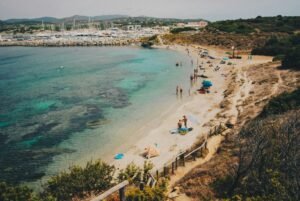
What the train does not reach: western Sicily’s beaches (San Vito Lo Capo, Scopello, Zingaro), the interior hill towns (Erice, Piazza Armerina, Caltagirone, Ragusa Ibla, and Modica); the archaeological sites outside the main cities; and most of the best beach coves on the southern and western coasts. For those destinations, you need a bus, a taxi, an organized tour, or a car.
Intercity Buses: Faster and More Useful Than the Trains
For many cross-island routes, the intercity bus is significantly faster, more frequent, and more convenient than the train. Several private operators run express coach services between the major cities using the autostrade, and the journey times are considerably better than the equivalent train trip.
Autolinee di Sicilia is the main regional bus network, formed by the consolidation of several local operators. It covers a wide range of routes across the island, including many smaller towns without train service. The website and app allow route searches and ticket purchases, though checking Google Maps for bus options between two points and then booking directly with the operator is often the easier approach.
Interbus runs the most important express route on the island: Palermo to Catania in about 2 hours 45 minutes via the A19 autostrada — nearly an hour faster than the train on the same journey. Interbus also operates Catania to Taormina (about 1.5 hours), Catania to Syracuse (1 hour), and a range of other routes in eastern Sicily. Tickets can be purchased on the Interbus website, at the bus terminal, or at affiliated tabacchi (tobacco shops) near the departure points.
SAIS Autolinee operates routes including Palermo-Messina, Palermo-Enna, and several other connections in central and eastern Sicily. Salemi buses serve the Trapani province, connecting Trapani, Marsala, and the western coast. AST (Azienda Siciliana Trasporti) is the regional state operator covering many smaller towns across the island.
⚠️ Sunday and holiday schedules: Bus services across Sicily drop dramatically on Sundays and public holidays — many routes run once or twice a day, or not at all. If you are planning a Sunday journey to a smaller town or site, check the schedule very carefully in advance. Building a buffer day or adjusting your itinerary around Sunday is wise.
Key Bus Routes and Journey Times
| Route | Operator | Journey time | Notes |
|---|---|---|---|
| Palermo → Catania | Interbus / Autolinee di Sicilia | ~2h 45min | Much faster than the train; several daily |
| Palermo → Trapani | Autolinee di Sicilia / Salemi | ~1h 30min | Faster than the train |
| Palermo → Agrigento | Autolinee di Sicilia | ~2h | Good alternative to the slow train |
| Catania → Taormina | Interbus / AST | ~1h 30min | Drops at Taormina or Giardini Naxos |
| Catania → Syracuse | Interbus | ~1h | Runs frequently |
| Trapani → Marsala | Salemi | ~40min | Also serviced by train |
Getting Around Within Cities
Palermo is the most transit-rich city in Sicily. The AMAT city bus network covers the entire metropolitan area, and the historic center is compact enough to cross on foot in 25–30 minutes. The main sights — the markets, the Palatine Chapel, the Norman palaces, the Kalsa — are all walkable from a central hotel. Taxis are inexpensive and available throughout the center for trips to the Capuchin Catacombs, Monreale, and other destinations outside the walkable core.
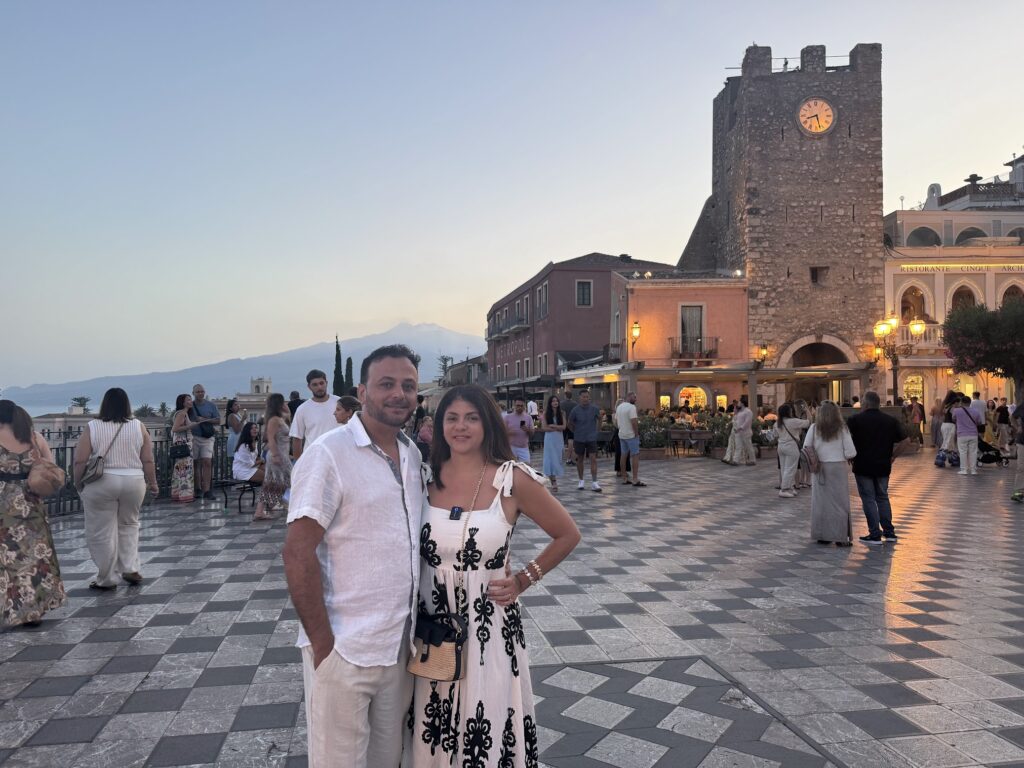
Taormina is arguably the easiest Sicilian town to navigate without a car. The old town on its clifftop is pedestrianized and everything is on foot. You arrive from the train station at Taormina-Giardini (actually in the beach town of Giardini Naxos below) on the AST bus, which runs every 15–30 minutes up the hill to Taormina’s Porta Messina. The cable car from the edge of the old town down to Isola Bella beach means beach days require no car or taxi. For day trips to Etna, organized minibus excursions depart from Taormina’s center.
Syracuse and Ortigia — the historic island at the city’s heart — is small enough to cover entirely on foot in an hour. The mainland archaeological park of Neapolis (the Greek theater, Roman amphitheater, Ear of Dionysius) is about 2.5km from the Ortigia bridge and reachable by local bus or taxi. The train station is on the mainland, a 15–20 minute walk from the island.
Catania has an AMT city bus network and a limited metro line — useful for reaching the airport and the outer neighborhoods, though the historic center is walkable. The main fish market (La Pescheria), the Duomo, and the Via Etnea shopping street are all in a compact area that does not require transit to navigate.
Ferries and Hydrofoils: Getting to the Islands
Several of Sicily’s best destinations are islands reachable by ferry or hydrofoil — and these routes require no car at all.
Egadi Islands (Favignana, Levanzo, Marettimo) — ferries and hydrofoils from Trapani port, operated by Liberty Lines and Grimaldi Lines. Favignana is 30 minutes by hydrofoil, Marettimo about 1.5 hours. Ferries run several times daily in season. Favignana has excellent beaches and is entirely navigable on foot or rented bicycle. See our full guide to Favignana.
Aeolian Islands (Lipari, Stromboli, Vulcano, Panarea and others) — ferries and hydrofoils from Milazzo, a town on the northeast coast about 45 minutes from Messina by train. Liberty Lines operates the hydrofoil service; Siremar and NGI run the slower car ferries. The Aeolians are one of the best multi-day excursions from the main Sicily itinerary and entirely car-free by design — the islands are too small for cars.
Ustica — a small volcanic island about 60km north of Palermo, famous for its clear water and marine reserve. Ferries and hydrofoils from Palermo’s port (Liberty Lines hydrofoil, about 1h 15min). A good day trip or overnight from Palermo.
Getting from the Airports
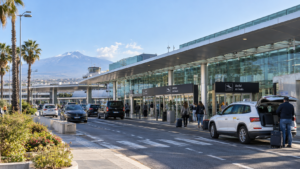
Palermo Falcone-Borsellino Airport — the Prestia e Comandè express bus runs between the airport and Palermo’s central bus terminal (Via Balsamo, near the train station) every 30–40 minutes, takes about 45 minutes, and costs around €6.50. Taxis from the airport to the centro storico run around €40–45 on the fixed rate. There is no direct train connection from the airport—the bus is the standard car-free option.
Catania Fontanarossa Airport is better connected: the Alibus shuttle runs to Catania’s central train station and Via Etnea every 25 minutes (about 20 minutes, €4), and from the train station you can connect directly to Taormina, Syracuse, and Palermo. Taxis to the center cost around €20–25.
Trapani Birgi Airport — a small airport handling mainly Ryanair seasonal flights. The Airgest shuttle bus connects to the Trapani city center in about 30 minutes.
Taxis and Private Transfers
Taxis in Sicily are inexpensive by European and American standards and are a practical supplement to public transit for filling the gaps — particularly for reaching archaeological sites, beaches, and attractions that are not on bus routes. Palermo and Catania have metered taxis; in smaller towns, agree on a price before getting in. A typical taxi from Taormina to the lower Etna visitor center costs around €50–70 one way; from Agrigento centro to the Valley of the Temples entrance about €10–15.
Private transfer services are available through several online platforms (Welcome Pickups, Get Transfer, and local Sicilian operators) and are worth considering for longer journeys or routes where bus connections require multiple changes. Booking a private driver for a full day — particularly for western Sicily, where the combination of Erice, the salt pans, and Segesta in one day is difficult by public transit — can be cost-effective when split between two or three travelers.
Organized Tours as a Car-Free Strategy
One of the most practical ways to travel car-free in Sicily is to take an organized day trip. Tour operators in Palermo, Taormina, and Catania run daily excursions to the Valley of the Temples, Etna (including crater access), the Baroque southeast (Ragusa, Modica, Noto), the Zingaro coast, and other car-dependent destinations. These are generally well-run, use comfortable minibusses, and include a guide who adds real context to the sites.
The best approach for many people is a hybrid: use public transit for the city-to-city connections, book organized excursions for the one or two car-dependent sites that are essential to the itinerary, and accept that some experiences — a quiet beach cove, a drive through the interior at your own pace — simply work better with a car. For more on deciding which approach fits your itinerary, see our guide to do you need a car in Sicily.
Practical Tips
Train tickets: Buy on trenitalia.com, the Trenitalia app, at station ticket machines, or at the staffed ticket window. For regional trains, no advance booking is necessary. Always validate before boarding.
Bus tickets: Buy on the operator’s website, at the bus terminal ticket counter, or at tabacchi near the departure point. Some smaller routes are cash-only on board — carry small bills. Google Maps gives reasonably accurate bus information for Sicily and is a good starting point for planning routes.
Seasonal changes: Bus and ferry schedules change significantly between the summer timetable (typically June–September) and the reduced winter schedule. Check current schedules directly with the operator rather than relying on third-party sites, which are often out of date.
Allow buffer time: Sicilian public transit runs late more often than on time. Build 20–30 minutes of buffer into any connection, and don’t plan a bus arrival that requires you to catch a train within 15 minutes at the other end.
For help planning which bases work best for a car-free itinerary, see our guide to the best places to stay in Sicily without a car.