Trapani and Erice are two of the most distinctive places in western Sicily, and they sit just 14 kilometers apart — the medieval hilltop town of Erice floating above the clouds at 750 meters, and the flat peninsula city of Trapani pointing west toward the Egadi Islands below. Together they make one of the best two-day combinations in all of Sicily: ancient Greek temples at Segesta nearby, the Zingaro coast to the north, the salt pans and windmills south toward Marsala, and ferry access to three of the best island destinations in the region.
Most visitors pass through Trapani briefly on the way to or from Favignana and the Egadi Islands. That is a mistake. The old town on its narrow peninsula, the couscous restaurants, the sunsets over the salt pans, and the cable car ascent to Erice are all worth considerably more time than an afternoon. This guide covers both towns and how to make the most of the area.
Erice: The Medieval Hilltop Town Above Trapani
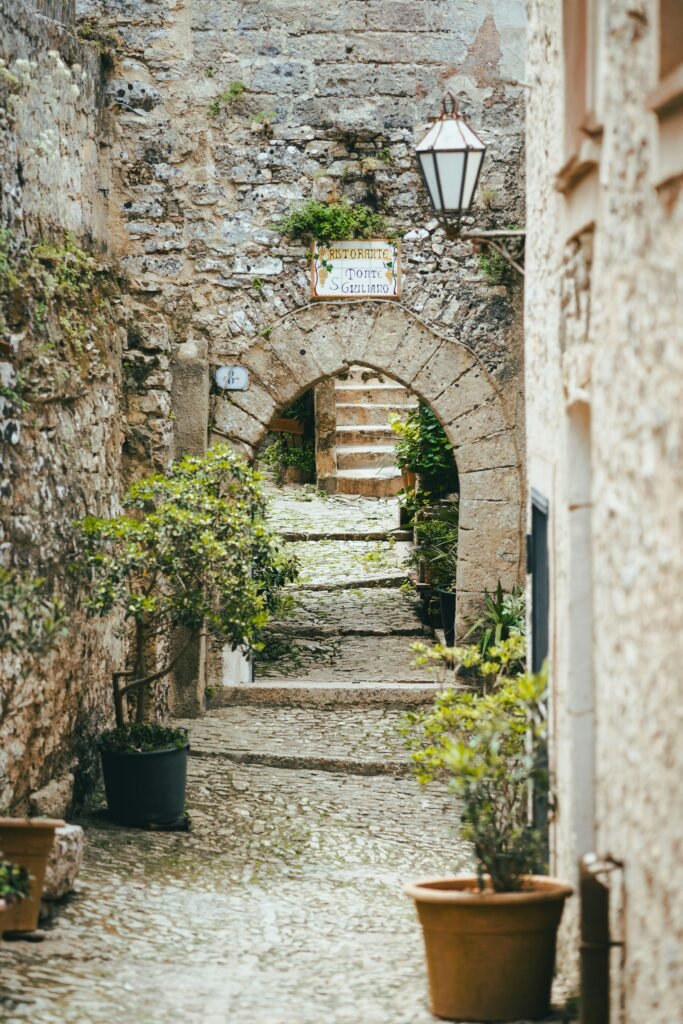
Erice sits at the top of Monte San Giuliano — a steep limestone peak rising abruptly from the flat western Sicilian coastline — and has been inhabited since before the Greeks arrived. The Elymians, one of Sicily’s pre-Greek indigenous peoples, built a sanctuary to their goddess Astarte here that the Greeks later dedicated to Aphrodite and the Romans to Venus. The location was chosen for its commanding views over the entire western tip of Sicily, the salt pans, the Egadi Islands, and on clear days, the coast of North Africa 160km away.
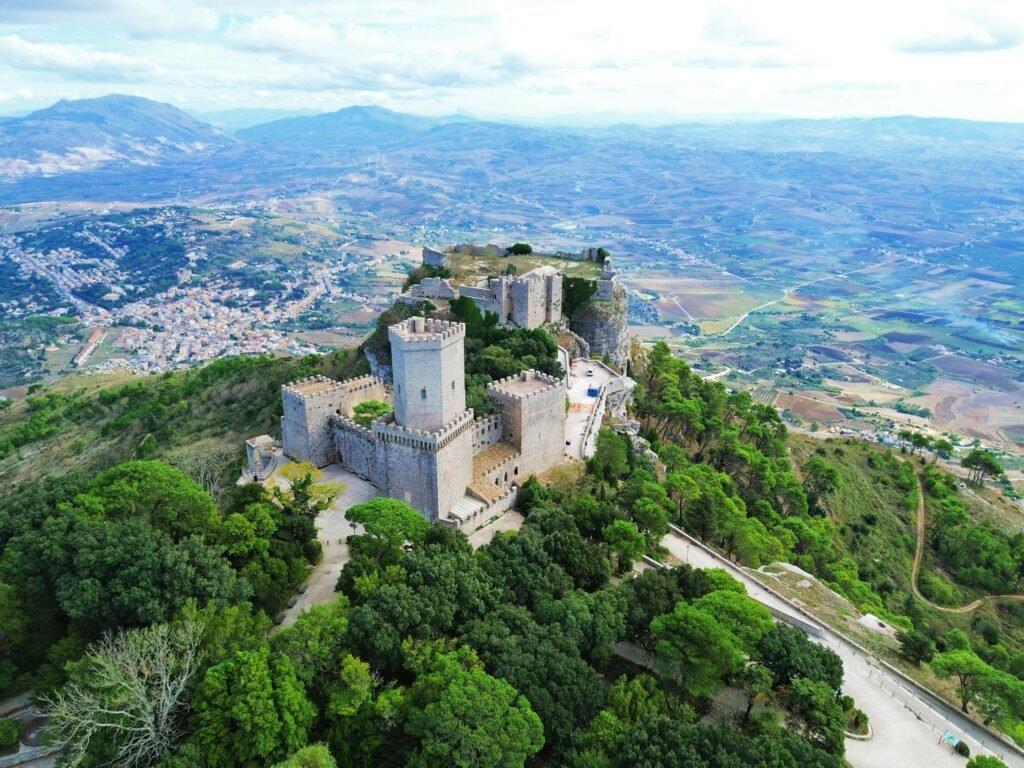
The town today is almost entirely medieval: narrow cobblestone streets barely wide enough for two people to pass, stone buildings draped in ivy, churches built over ancient foundations; and the Castello di Venere at the highest point — a Norman castle built on the site of the ancient temple, its towers still standing above the cliff edge. Walking Erice feels less like tourism and more like genuine time travel. Even in high season, the streets are quiet compared to Taormina or Cefalù; Erice draws day-trippers, but it never feels overwhelmed.
What to See in Erice
The Castello di Venere at the northeastern tip of the town is the main landmark and should be your first stop. Walk through the castle gardens to the cliff edge for views that take in the entire coastline from Trapani north to San Vito Lo Capo and, on clear days, Ustica island far out to sea. The castle itself is partially ruined but retains its Norman towers and walls — a small admission fee covers entry.
The Duomo di Erice (Cathedral of the Assumption) in the main piazza dates from the 14th century and has a detached bell tower that originally served as a watchtower. The interior is relatively plain, but the square in front — the Piazza della Loggia — is one of the nicest in western Sicily for sitting with a coffee. The Museo Cordici, attached to the town hall, houses a collection of local antiquities, including an impressive marble head of Aphrodite, believed to be a Roman copy of a Greek original from the temple.
Erice is famous throughout Sicily for its almond pastries — the genovesi (pastry shells filled with custard cream) and the almond paste sweets sold in the small pasticcerie along the main street are the best version of these you will find anywhere on the island. Maria Grammatico’s pastry shop, which has been operating for decades on the main corso, is the most celebrated of these and is genuinely worth seeking out.
Getting to Erice: Cable Car or Drive
The classic way to reach Erice from Trapani is the funivia — the cable car that runs from Trapani’s Piazza Stazione up the steep mountainside to the edge of Erice in about 10 minutes. The journey itself is spectacular: you ascend from sea level through orchards and rocky terrain to emerge above the cloud line (when there is mist) or into a panoramic view over the entire coastline below. The funivia runs regularly throughout the day and is the best approach from Trapani without a car.
By car, the road from Trapani winds up the mountain in a series of tight switchbacks and takes about 25 minutes. Parking is available in two lots at the edge of the old town (the center itself is closed to traffic). Driving gives you the flexibility to continue directly to San Vito Lo Capo or Segesta without returning to Trapani.
Trapani: The Peninsula City
Trapani’s old town occupies a narrow spit of land pointing west into the sea — a configuration that gives the city a distinctive character, with the sea visible at the end of almost every street in the historic center. The city faces west, which means the sunsets here are exceptional: standing on the waterfront at the tip of the peninsula as the sun drops toward the Egadi Islands on the horizon is one of the best free experiences in western Sicily.
The historic center is flat and entirely walkable. The main street, Corso Vittorio Emanuele, runs the length of the peninsula from the newer city gate to the western tip. Along this street and in the lanes immediately around it you will find the best of Trapani: the cathedral, the oratory of Sant’Anna, the best seafood restaurants in the city, and the covered market at Piazza Mercato del Pesce, where the morning fish auction draws locals from across western Sicily.
Couscous and Seafood: Eating in Trapani
Trapani is one of the best places in Sicily to eat, and the dish most associated with the city is couscous al pesce — couscous with fish broth, a direct legacy of the Arab presence in western Sicily and the centuries of contact with North African fishermen in the waters between Trapani and Tunisia. The Sicilian couscous tradition is different from the North African version: the couscous is steamed over a fish broth for hours and served with a soup of mixed fish, shellfish, and vegetables. It is one of the most distinctive dishes in all of Italian cooking and Trapani is where you eat it best.
Tuna is also central to the Trapani food tradition — the mattanza (the traditional bluefin tuna hunt) was practiced in the waters off Favignana for centuries, and tuna in all forms (fresh, dried as bottarga, preserved in oil) appears on menus throughout the city. The local pasta is busiate al pesto trapanese — a hand-rolled spiral pasta with a pesto made from almonds, tomatoes, basil, and garlic rather than the Genoese pine nut version. It is exceptional.
Check out Favignana, Trapani.
The Salt Pans: Saline di Trapani e Paceco
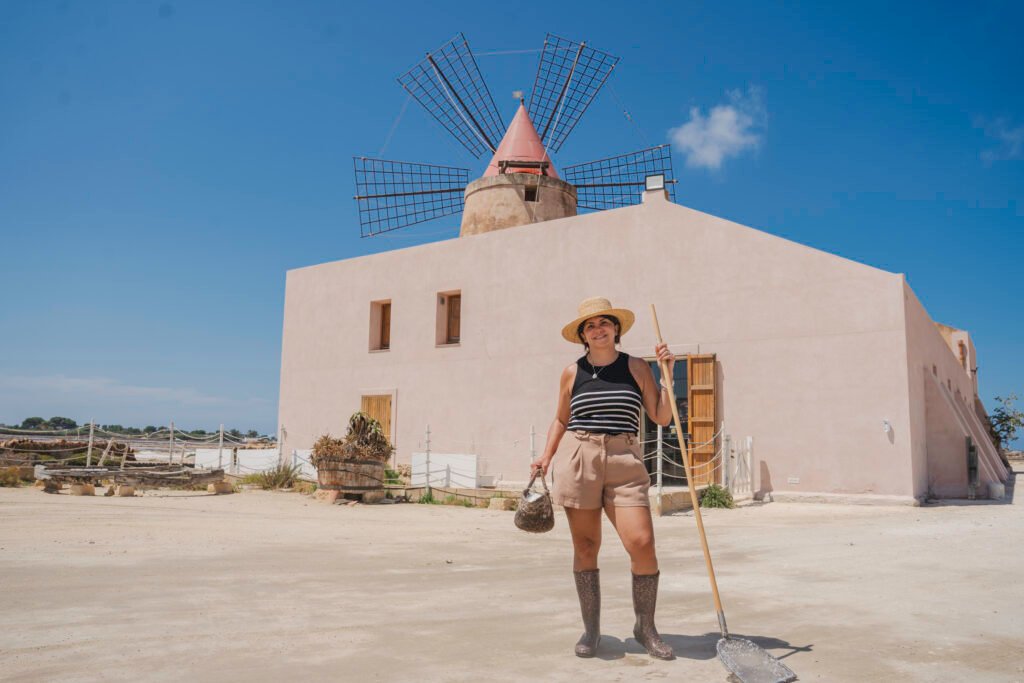
The stretch of coast between Trapani and Marsala is covered by the Saline di Trapani e Paceco — a nature reserve of working salt pans, windmills, and shallow lagoons that turns extraordinary colors at sunset. The windmills — traditional Sicilian mulini a vento — were used to pump water between the pans and grind the harvested salt; several have been restored and a salt museum operates in one of them.
The salt pans are pink and orange in the late afternoon light, filled with flamingos during migration season (spring and autumn), and the combination of working windmills, shallow pans reflecting the sunset, and the Egadi Islands on the horizon is one of the most photogenic landscapes in Sicily. The viewing area at Nubia, about 10km south of Trapani, is the best spot for sunset photography. This is an easy 30-minute detour from Trapani if you have a car.
Day Trips from Trapani
Segesta (35km northeast) — one of the best-preserved Greek temples in the world, standing alone on a hillside with an ancient theater higher up. Allow 1.5–2 hours. Easy half-day trip from Trapani.
Favignana and the Egadi Islands — ferries from Trapani port run throughout the day to Favignana (30 minutes), Levanzo (30 minutes), and Marettimo (1.5 hours). Favignana has excellent beaches and the historic tuna processing plant (now a museum). For the full guide, see our article on Favignana.
San Vito Lo Capo (40km north) — the best beach in the Trapani province, a long arc of white sand with turquoise water and a small beach town. An easy day trip by car; less practical without one.
Marsala (30km south) — the wine town and home of the fortified wine that bears its name. The Mothia island archaeological site (a Phoenician city in the Stagnone lagoon) is reachable by a short boat trip from Marsala and is one of the most interesting sites in western Sicily. See our full guide to where to stay in Marsala.
Where to Stay: Trapani or Erice?
Stay in Trapani if you want easy access to the ferry port for Egadi Islands day trips, the best restaurant options, and the flexibility of a flat, walkable city with good connections to the rest of western Sicily. The old town has a range of B&Bs, boutique hotels, and apartments that are well-priced by Sicilian standards.
Stay in Erice if the medieval atmosphere is the priority — waking up above the clouds, the town in the morning before the day-trippers arrive, and the views from the castle at dawn and dusk. Accommodation in Erice is limited (a handful of small hotels and B&Bs) and needs to be booked well in advance in summer. The tradeoff is that everything requiring a car or ferry becomes less convenient.
Getting to Trapani
By car: Trapani is about 100km from Palermo (1h 45min on the A29 autostrada) and the most practical way to reach the area if you are doing a western Sicily circuit. The drive from Palermo along the A29 is fast and straightforward.
By train: Trains run from Palermo to Trapani (about 1h 45min–2hrs) several times a day. The station is on the edge of the old town and walkable to most accommodation.
By bus: Autolinee di Sicilia and other operators run express buses from Palermo to Trapani that are often faster than the train (about 1h 30min). The bus drops you at the Trapani bus terminal near the train station.
Trapani Airport: Trapani Birgi Airport handles mainly low-cost European flights (Ryanair has a seasonal base here). If you are flying into Trapani rather than Palermo, this is a convenient gateway for western Sicily. For car rental and getting around the region, see our guide to renting a car in the Trapani area.
Best Time to Visit Erice and Trapani
May, June, and September are ideal for western Sicily. The sea is warm for swimming, the salt pans are actively harvested (the harvest runs July–September, but the landscape is photogenic all summer), and the beaches at San Vito Lo Capo are at their best without the August peak crowds. Erice in May and early June has wildflowers on the slopes below the town and clear visibility from the castle walls before the summer haze builds.
September is particularly good for the area: the Cous Cous Fest in San Vito Lo Capo (third or fourth week of September) is one of the best food events in Sicily and makes an excellent reason to base yourself in western Sicily for that week. Accommodation prices drop significantly from their August peak. For a broader guide to timing, see our article on Sicily in September.